3/30/2014

Airplane Black Boxes .


                                                                            Airplane Black Boxes


Diagram of Data Flow to Aircraft Black Boxes
 
In the past decade, the discipline of Human Factors has become instrumental in determining the causes of Aircrafts Accidents. So, however, the disappearance of Malaysia Airlines flight MH370 has absorbed the imagination what’s going on here? Unanswered questions such as why the communication system was disabled, and why the aircraft apparently executed a turn to the left before it disappeared have deepened the mystery, no distress call has reported. But this is not the first time a plane has gone missing, in my personal and objective opinion the box records cockpit communications is a key here to find all the evidence to solve this accident.


The history of aircraft recording devices is somewhat stony, interestingly enough; the first flight data recorder was installed by the Wright Brothers on their original airplane in 1903. The installed a device that recorded engine RPM, time and distance traveled. From then on, not much was heard about recorders until we entered the Jet era.

So, as Aircraft System and Cockpits became more sophisticated, aircraft accident investigation became harder, but there was less evidence remaining after the crash. So, meanwhile, aircraft accidents were becoming more expensive and less acceptable, a solution designed solely to help the investigator was the Flight Data Recorder (FDR) and the Cockpit Voice Recorder (CVR).

Let’s review a brief history of Black Boxes: It can resist temperatures up to 2,000°F and impact forces of 3400 Gs /6.5ms, the secrets of airplane crashes, including what went wrong and why. So the color it's not black at all it’s actually orange. Popularly referred to as a "black box" by the media when a fatal crash is reported.


Specification:
Time recorded .......................... 30 min continuous, 2 hours for solid state digital units
Number of channels ................. 4
Impact tolerance ...................... 3400 Gs /6.5ms
Fire resistance .......................... 1100 deg C /30 min
Water pressure resistance ........ submerged 20,000 ft
Underwater locator beacon ...... 37.5 KHz
Battery: 6yr shelf life
30 day operation
 
Who Invented The Black Box?

The Black Box was invented by an Australian scientist named Dr. David Warren. Though Warren was working at the Aeronautical Research Laboratory in Melbourne in the mid-1950s he was involved in the accident investigation surrounding the mysterious crash of the world’s first jet-powered commercial aircraft, the Comet. Understanding that it would have been useful for investigators if there had been a recording of what had happened on the plane just before the crash, he got to work on a basic flight data recorder. The first demo unit was produced in 1957, but it was not until 1960, after an unexplained plane crash in Queensland, that Australia became the first country in the world to make the Black Box mandatory for all commercial aircraft.

The data recorded by the Flight Data Recorder (FDR) is used for accident investigation, as well as for analyzing air safety questions, material degradation and engine performance, also another kind of flight recorder is the cockpit voice recorder (CVR), which records conversation in the cockpit, radio communications between the pilots including conversation with air traffic control staffs.

As technology continues to develop it is likely that Black Boxes, or flight data recorders, will become more and more sophisticated and more reliable, giving to Aviation Accident Investigators more to go on when thoroughly trying to piece together what caused a plane crash.

This part will be essential to resolve was what happened with the Malaysia Airlines flight MH370, hopefully soon the investigators can find this device to resolve this mystery never ever seen in commercial aviation.
 

3/10/2014

Midair Collision Avoidance / Your Role in Collision Avoidance


Midair Collision Avoidance

YOUR ROLE IN COLLISION AVOIDANCE


Recent studies of midair collisions involving aircraft by the National Transportation Safety Board (NTSB) determined that:

Most of the aircraft involved in collisions are engaged in recreational flying, not on any type of flight plan.

ü  Most midair collisions occur in VFR weather conditions during weekend daylight hours.

ü  The vast majority of accidents occurred at or near uncontrolled airports and at altitudes below 1000 feet.

ü  Pilots of all experience levels were involved in midair collisions, from pilots on their first solo ride, to   20,000-hour veterans.

ü  Flight instructors were on board the aircraft 37 percent of the accidents in the study.

ü  Most collisions occur in daylight with visibility greater than 3 miles.


Here's how you can contribute to professional flying and reduce the odds of becoming involved in a midair collision.


1.  Practice the "see and avoid" concept at all times regardless of whether the operation is conducted under Instrument (IFR) or Visual (VFR) Flight Rules.

2.  Under IFR control, don't always count on ATC to keep you away from other aircraft.  They're human, and can make mistakes.

3.  Understand the limitations of your eyes and use proper visual scanning techniques.  Remember, if another aircraft appears to have no relative motion, but is increasing in size, it is likely to be on a collision course with you.

4.  Execute appropriate clearing procedures before all climbs, descents, turns, training maneuvers, or aerobatics.

5.  Be aware of the type airspace in which you intend to operate in and comply with the applicable rules.

6.  Adhere to the necessary communications requirements.

7. Traffic advisories should be requested and used when available to assist the pilot’s own visual scanning -- advisories in no way lessen the pilot’s obligation to see and avoid.

 8.  If not practical to initiate radio contact for traffic information, at least monitor the appropriate frequency.

 9.  Make frequent position reports along your route and AT UNCONTROLLED AIRPORTS BROADCAST YOUR POSITION AND INTENTIONS ON COMMON TRAFFIC ADVISORY FREQUENCY (CTAF).

 10.  Make your aircraft as visible as possible - turn on exterior lights below 10,000 MSL and landing lights when operating within 10 miles of any airport, in conditions of reduced visibility, where any bird activity is expected or under special VFR clearance.

11.  If the aircraft is equipped with a transponder, turn it on and adjust it to reply on both Mode 3/A and Mode C (if installed).  Transponders substantially increase the capability of radar to see all aircraft and the MODE C feature enables the controller to quickly determine where potential traffic conflicts exist.  Even VFR pilots who are not in contact with ATC will be afforded greater protection from IFR aircraft receiving traffic advisories.

IN ACCORDANCE WITH FAR PART 91.413, WHILE IN CONTROLLED AIRSPACE, EACH PILOT OPERATING AN AIRCRAFT EQUIPPED WITH AN OPERABLE ATC TRANSPONDER MAINTAINED SHALL OPERATE THE TRANSPONDER, INCLUDING MODE C IF INSTALLED, ON THE APPROPRIATE MODE OR AS ASSIGNED BY ATC.  IN CLASS G AIRSPACE, THE TRANSPONDER SHOULD BE OPERATING WHILE AIRBORNE UNLESS OTHERWISE REQUESTED BY ATC.

 12.      ABOVE ALL, AVOID COMPLACENCY


Promoting Aviation Safety is the key .

2/27/2014

Why you should know more about Mid Air Collisions?


Why you should know more about Mid Air Collisions?


As you read this Safety Blog, I ask you to read and pay close attention why accidents happen?

On my previous post I wrote about and How to Avoid a Mid Air Collision? So, through the many stories regarding incidents and accidents I offer look to all Pilots that seem familiar with this term, why you should know the Causes of Midair’s.

I want to share today a very interesting post, what causes in- flight collisions? Certainly, increasing traffic and higher closing speeds represent potential, so for instance a Jet and a Light Twin have a closing speed of about 760 mph. It takes a minimum of 10 seconds, says the FAA, for any Pilot to spot traffic, identify it, realize it’s a collision threat, react and have his aircraft respond, but two planes converging at 740 mph will be less than 10 seconds apart when pilots are first able to detect each other, these problems are heightened by the fact that our air traffic control and radar facilities are in some cases, overloaded and limited.

These are all casual factors, but the reason most often noted in the statistics reads (Failure of Pilot to see other aircraft) – failure of the see-and –avoid system. In most incidents and accidents, so at least one of the pilots involved could have seen the other in time to avoid contact, if he had just been using his eyes properly, so it’s really that complex, vulnerable little organ-the human eye –which is the leading cause of in-flight collision. Always take a look at how its limitations affect your flight.

Studies of the midair collision problem from certain definite warning patterns, it may be surprising to some that nearly all midair collisions occur during daylight hours and in VFR conditions.

Maybe not so surprising is that the majority happen within five miles of an airport, in the areas of greatest traffic concentration, and usually on warm weekend afternoons when more pilots are doing more flying. Not looking out at all, and /or completely blocking your peripheral vision, is an invitation to an in-flight collision.

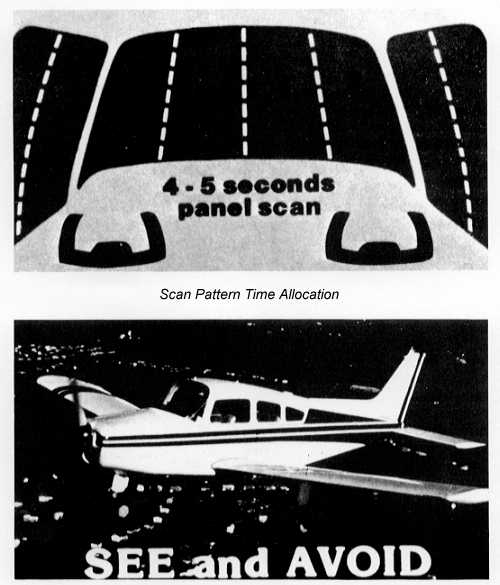
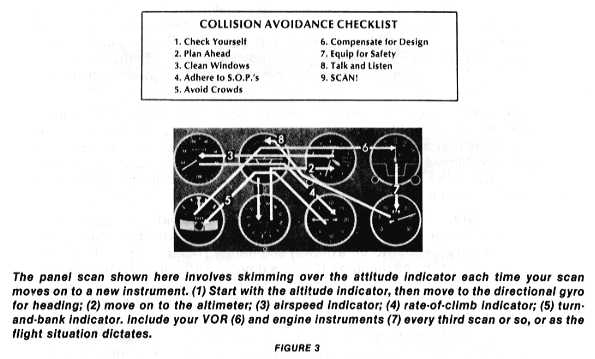
Always consider How to Scan, Scan Patterns, The Time –Sharing Plan, the Panel Scan inside your cockpit, and use continuously the Collision Avoidance Checklist. So, Collision Avoidance involves much more than proper eyeball techniques, you can be the most conscientious scanner in the world and still have an in –flight collision if you disregard other important factors in the overall see-and avoid picture, constantly it might be helpful to use a Collision Avoidance Checklist as you do in your routine pre takeoff and landing list, so, such a Checklist might include the following nine items and be aware at all times of your flight:

1.       Check Yourself.

2.       Plan Ahead.

3.       Clean Windows.

4.       Adhere to SOPs.

5.       Avoid Crows.

6.       Compensate for Design.

7.       Equip for Safety.

8.       Talk and Listen.

9.       Scan: This is the most important part of your Checklist of course, is to keep looking where you are going and to watch for traffic, don’t forget make use of your scan constantly.


These power strategies are to help you to think safety in your flights.

There is no way to say whether the inexperienced pilot or the older, more experienced pilot is most likely to be involved in an in – flight collision. A begging pilot has so much to think about he may forget to look around, on the other hand , the older pilot,  having sat through many hours of boring flight without spotting any hazardous traffic , may grow complacent and forget to scan. No pilot is invulnerable. (Source AOPA)


2/21/2014

FAA Issues Final Rule to Improve Helicopter Safety


FAA Issues Final Rule to Improve Helicopter Safety.

I would like to share this actual and important information for all Helicopter Pilots, my interest is to promote Aviation Safety , not only Pilots who fly airplanes , this final rule is to persuade Helicopters Pilots to fly safe all the time, planning and shaping a good flight  is the Key to avoid accidents .

WASHINGTON – The U.S. Department of Transportation’s Federal Aviation Administration (FAA) today issued a final rule that requires helicopter operators, including air ambulances, to have stricter flight rules and procedures, improved communications, training, and additional on-board safety equipment. The rule represents the most significant improvements to helicopter safety in decades and responds to government’s and industry’s concern over continued risk in helicopter operations.


“This is a landmark rule for helicopter safety,” said Transportation Secretary Anthony Foxx. “These improvements will better prepare pilots and better equip helicopters, ensuring a higher level of safety for passengers and crew.”


All U.S. helicopter operators, including air ambulances, are required to use stricter flying procedures in bad weather. This will provide a greater margin of safety by reducing the probability of collisions with terrain, obstacles or other aircraft.


Within 60 days, all operators will be required to use enhanced procedures for flying in challenging weather, at night, and when landing in remote locations. Within three years, helicopter air ambulances must use the latest on-board technology and equipment to avoid terrain and obstacles, and within four years, they must be equipped with flight data monitoring systems.


“This rule is a significant advancement in helicopter safety,” said FAA Administrator Michael Huerta. “This rule will help reduce risk and help pilots make good safety decisions through the use of better training, procedures, and equipment.”


Under the new rule, all Part 135 helicopter operators are required to:

Equip their helicopters with radio altimeters.

Have occupants wear life preservers and equip helicopters with a 406 MHz Emergency Locator Transmitter (ELT) when a helicopter is operated beyond power-off glide distance from the shore.

Use higher weather minimums when identifying an alternate airport in a flight plan.

Require that pilots are tested to handle flat-light, whiteout, and brownout conditions and demonstrate competency in recovery from an inadvertent encounter with instrument meteorological conditions.


In addition, under the new rule, all air ambulance operators are required to:

Equip with Helicopter Terrain Awareness and Warning Systems (HTAWS).

Equip with a flight data monitoring system within four years.

Establish operations control centers if they are certificate holders with 10 or more helicopter air ambulances.

Institute pre-flight risk-analysis programs.

Ensure their pilots in command hold an instrument rating.

Ensure pilots identify and document the highest obstacle along the planned route before departure.

Comply with Visual Flight Rules (VFR) weather minimums, Instrument Flight Rules (IFR) operations at airports/heliports without weather reporting, procedures for VFR approaches, and VFR flight planning.

Conduct the flight using Part 135 weather requirements and flight crew time limitation and rest requirements when medical personnel are on board.

Conduct safety briefings or training for medical personnel.

Since August 2004, the FAA has promoted initiatives to reduce risk for helicopter air ambulance operations (See FAA Fact Sheet). While accidents did decline in the years following that effort, 2008 proved to be the deadliest year on record with five accidents that claimed 21 lives. The FAA examined helicopter air ambulance accidents from 1991 through 2010 and determined 62 accidents that claimed 125 lives could have been mitigated by today's rule. While developing the rule, the FAA considered 20 commercial helicopter accidents from 1991 through 2010 (excluding air ambulances) that resulted in 39 fatalities. From 2011 through 2013, there were seven air ambulance accidents resulting in 19 fatalities and seven commercial helicopter accidents that claimed 20 lives.


The estimated cost of the final rule in present value for the air ambulance industry is $224 million with a total benefit of $347 million over 10 years. The cost for other commercial operators is $19 million with a total benefit of $83 million over 10 years. There is no cost for any operators to use new Class G airspace weather minimums for visual flying but the benefit is $147 million over 10 years.


The rule responds to the FAA Modernization and Reform Act of 2012 and National Transportation Safety Board recommendations.


2/14/2014

Understanding What is Fog?


Understanding What is Fog?

 
Approaching in lowest Visibility
 
Most Aircraft accidents related to low ceilings and visibilities involve pilots who are not instrument qualified. So, basically stated, Fog is a cloud that forms and remains close to the ground.


As Pilots always we are consistently about their problems about the weather, and also the cause and effects why accidents happen.
 
I believe when I’m writing  interesting articles to promote safety on my blog , it is with the only purpose to understand incidents and accidents in General Aviation. So writing is a way of discovering and learning, writing is a way of thinking and reflecting , also writing is a way of owing and sharing knowledge. To me writing what I learned in college is the way to communicate a message for a purpose to understand different concepts relating Aviation Safety.

What is the major purpose for writing on this Safety Blog? A writer purpose for me writing is the motivating force behind what’s being written to avoid incidents and accidents.
 

Let’s continue understanding more what that mean fog to you as a pilot? Fog is a surface based cloud composed of either water droplets or ice crystals. Fog is the most frequent cause of surface visibility below 3 miles, and is one of the most common persistent weather hazards encountered in Aviation.

The rapidity with which fog can form makes it particularly hazardous to all pilots if you don’t understand well the idea about the term fog.

Several factors, including high humidity, abundant condensation dust particles, water droplets or ice crystals, little or no wind, and cooling promote the formation of fog.

Clouds and fog form in air that is saturated with water vapor. So, air is said to be saturated when it reaches 100 % water vapor content for a given temperature. The higher the temperature, the more water vapor a given volume of air can hold. For every 20 degrees Fahrenheit increase in air temperature the air capacity to hold water vapor is doubled.   

Therefore when a meteorological condition is telling us that a relative humidity is 45% is saying that the air is 45% saturated with water vapor, so the most important indicator at this point of probable conditions for fog formation is the temperature dew point spread the dew point being that temperature to which air must be cooled to become saturated, as the dew point and air temperature approach each other, the possibility of fog increases.    

There are several different types of fog that any Commercial or Private Pilot must know to recognize and to be familiar with each type of fog in order to fly safely in any fog conditions during  approach whit the effects on fog flying , always remember there are several operational complications to be considered when dealing with fog .

Types Of Fog : Radiation Fog, Advection Fog , Upslope Fog , Precipitation Induced Fog , Steam Fog , Ice Fog , Smog ( is a phenomenon closely related to fog ).


There are a few rules that can help pilots anticipate and deal with fog, so always my best advice to all pilots, is be aware that although fog is more prevalent in late fall and early winter time, and also can occur during any season of the year.

So well, fog particularly during the time of the year when the temperature is generally cooler too. Also another tip, the possibility of fog exists, even though you might be in the clear sky at the moment when will be approaching at the field.

Most Pilots involved in weather related accidents that resulted in fatal consequences, comprehensive, timely weather information and a good prefight planning is the key to fly safely all the time.

Any Pilot knows how to make a Go Around on time, a good pilot knows when.

I sincerely believe you will enjoy this interesting post and at the same time increase your flying safety knowledge’s.


2/09/2014

Stress and the Pilot.


Stress and the Pilot
Pilots Under Stress
The term Pilot Stress is a familiar one


This post is written for all Pilots who read my Safety Blog, so is to help us understand and identify lifestyle and flying related stress and the role that these can play in our Aviation lives.

Over the 80 % of all General Aviation Accidents are human error related. It is very important that stress and even the lack of stress can be a Key factor in human error.

Getting to know yourself, and how you respond to stress. The difference between one pilot and another in managing with stress while flying is in the amount of stress (experience) and how each individual reacts to pressure. There can be not set answer. It is not the purpose here on my blog to scare nor is it to say that all stress is bad. So, there is a stress level for each one of us as pilots where personal caution flags should go up, where you as a professional and a safety pilot or I think whether or not that stress could obstruct our normal healthy ability, to fly an airplane and to react in an abnormal emergency situation. The most important to all pilots is to learning to leave life style stress out of the cockpit is the key to long term persistence, learning to recognize the need to place stress reminders all pilots that the preflight decision making process can prevent incidents and accidents.

So, let’s describe short what that mean the word stress : on my readings some human factors books for general aviation , highlights that the term stress originates from engineering where it refers to the force placed upon an object to cause straining , bending , or breaking. In the human context, stress is commonly used to describe the body’s responses to demands placed upon it, whether these demands are pleasant or unpleasant. Anything that cause stress is called stressor.

It is very important that all pilots can recognizes stress for what it is and what it is not. So every pilot experiences stress, we are humans and nothing is perfect in our lives, the most essential it is to learn to any sign of perception of stress as a valued personal flying decision making tool. Being alert to the presence of stress permits any pilot to use procedures or precautions which reduce the effect that this stress may have our ability to Fly Safely.   

So, emotions are an enormously powerful set of forces in human nature. When you fly your airplane, emotions can have a remarkable influence on your ability to perform well, mostly when it comes to issues of judgment.


I would like to share this interesting introduction reading as I read on a safety pamphlet written for the AOPA Air Safety Foundation.

Pilots come in all sizes, shapes and ages. We come from different family backgrounds, different economic situations and have varying flight experience. Not two of us are exactly alike. Yet, we face that the same challenges in the air. We take off, fly and land. Regardless of whether we are flying a homebuilt, a Piper or Beech, a Lear or Gulfstream, or a B767, we must address the same challenges in flight.

Some of us are more psychological resilient and less susceptible to stress than others. But, each of us faces stress to a degree. Each of us will cope in differing ways. In that ability to cope lies an almost secret Key to individual pilot safety and accident prevention.

Understanding stress and its potential impact can be difficult. Recognizing stress is even more difficult because as we mature, we build defense mechanisms in the process of gaining experience.

These defense mechanisms alter our ability to admit to ourselves that the pressures of life or specific situations are indeed stressful. Psychologist tells us that our reactions to various forms of stress are also based on the physiological and physiological characteristic with which we are born. What can be stressful at one point in our lives may not be stressful later. The much married person is a lot calmer at his or her sixth marriage than at the first one. The soaring pilot can be a lot more resourceful and less stressed should his engine fail than the pilot who has always depended on that noise up front.  (Source AOPA)

My only purpose writing this article, is to share my thoughts and experiences, and perhaps you may gather something useful from them, what that mean stress to you, so this word and issue is very long to describe and is very interesting to read much more about this area to stay away from incidents and accidents, writing for me safety issues like this one give me and idea to express exactly what I wish to communicate, so I truly hope you will. Improve Safety in aviation is the KEY, remember as you make decisions in the airplane, you are influenced by your mental state and the extent to which you may be under mental stress. Always you as a good Safety professional airmen try to recognize stress and how to deal with it.

Safe Pilots, Safe Skies.


1/25/2014

Why do planes still crash?


Why do planes still crash?


This is an interesting article to share with all the Aviation Community, was published two years ago.
So, lessons learned why accidents happened, the contents of this article explain some good aspects the clear and realistic lessons that have evolved from these accidents. In turn, all Pilots will learn ways to customize those lessons into practical techniques that incidents or accidents can happen to any crew no matter how much flight time you are gathering during your career as a Pilot. Fly safely all the time!!!

 
Improving Aviation Safety is the KEY, Safety is everybody’s Business !!!

Why do planes still crash?

Editor's note: Bill Voss is president and CEO of the Flight Safety Foundation, a group dedicated to improving aviation safety. He was previously director of the Air Navigation Bureau at the International Civil Aviation Organization, and spent 23 years working at the U.S. Federal Aviation Administration.

(CNN) -- By now, everyone should know that aviation is the safest way to travel: Even in parts of the world with a "high" accident rate, that rate is still far below other ways to get from point A to point B.

This level of safety is due to a tradition of hard work and technological advances that must continue.

New threats emerge every day, but through proactive efforts in data collection and analysis, we don't have to wait for an accident anymore -- we can mitigate these risks before they become real problems.

So how do we square those facts with terrible tragedies such as Air France 447? Plane crashes do still occur, even with state-of-the-art aircraft. Everyone in the industry must continue to work hard on safety.

With the Air France 447 final report published this week, we now have a clearer picture of the events that led to this tragedy. The report concluded that a series of errors by pilots and a failure to react effectively to technical problems led to the crash.

We already knew much of what we happened that evening: The autopilot shut itself off when the air speed indicators failed and the plane "handed itself" to the co-pilot. For the next several minutes, it should have been a pretty benign situation, but the flight crew made some inexplicable decisions and ultimately the plane crashed in the ocean.

What we must now try to understand is why the pilots reacted the way they did.

In the past decade, we've seen tremendous advances in automation in the cockpit. This automation has proven to be vital to raising the level of safety in aviation even higher and also to provide more efficient airline operations. It has removed some of the threat of human error during normal operations. Pilots now spend most of their time monitoring the automation.

But what happens when the automation turns itself off or fails for some reason?

Q&A: Has Air France Flight 447 mystery been solved?

The elephant in the room has always been that training standards have not kept up with the technological changes in aircraft.

In the early days of aviation, training included how to recover from some of the most commonly-faced emergencies, such as a lost engine during takeoff. These scenarios are no longer common, yet the training has not changed significantly to recognize this new reality. Automation used to be the pilot's assistant. Now the pilot is expected to back-up the automation. That is a fundamentally new task that the industry hasn't trained for.

Regulators around the world need to acknowledge this and work to change the basic requirements in training programs.

Pilots need to know what it feels like to stall at high altitudes and train on how to recover. They need to know what to do when an airplane is suddenly handed to them during an abnormal flight situation by the autopilot turning off. They need to learn what to do and perhaps most importantly, what not to do in order to avoid increasing risk.

Some of this will require a renewed emphasis on manual flying skills, but new training will also have to be developed to address the fundamental new relationship that has developed between man and machine.

There are a number of airlines around the world who are already changing their training standards to reflect this and we applaud this effort. All airlines should do this. They should not wait for their regulators to act.

As with any tragedy, there will be a temptation to focus on blame and political posturing, but AF447 is a case where politicians and judges should keep a respectful distance. There is some serious technical work to be done, and the aviation community needs to act quickly and objectively.

It is a responsibility that the entire aviation community embraces and we are confident that the safety professionals will find solutions that ensure that tragedies like this don't happen again.

It is a debt we owe to those who have been lost.