4/27/2014

What are you doing to improve Aviation Safety?


Prevention of Accidents: CRM


"The Learning method in our every day job functions every day is a constant process that never ends.

As a professional in our particular duties as Pilots, Flight Attendants, Maintenance etc., we must be constantly able to work together in a safety environment. This is even more important when you consider that this efficiency may depend our lives and the lives of others when we flying an airplane.

Being updated every day as a Crew implies learning.

Today the constant development of aviation brings several extremely high loads of new responsibilities and tasks for those directly involved in the operation of an aircraft from the crew on board and ground maintenance personnel to air traffic controllers, to many others.

Aviation is not just boarding a plane, but also is to understand the principles that allow an aircraft to fly, but do safely. It is very important to understand the ability to understand the knowledge, as an airmen, why your aircraft fly, this emphasize how important it is that flight crews receive proper training and appropriate, not only to fly the aircraft correctly it is also to be prepare for any situation you will expect and resolve in any abnormal situation or circumstances that we can have during the flight.

From the beginning CRM, initially recognized as a Cockpit Resource Management. This concept after some years becomes much wider doctrine, being known until today as Crew Resource Management.

The CRM emphasizes the importance of using all available resources effectively to achieve air operations safer and more efficient. The goal of CRM is to improve every day the ability of the crew in a decision-making, administration and management of the resources available and have a good communication with the rest of the crew and other elements involved in the safest operation of the aircraft.

But CRM does not end here, because the operation is more deeply involved with two other important aspects in the training of flight crews, human factors and the organizational culture ,it is very important issues.

Statistically, the vast majority of air accidents occurring at present point one of the main cause are 80 % sometimes described as a Pilot Error. All of us in the aviation environment related or not specifically, when a plane crash we wonder many things and questions, when we read in the newspapers or listen to reports on the media the phrase that summarizes what happened  when an airplane crashed we think was a pilot error????? . Not necessarily incompetence or lack of experience.

Some factors influencing a decision-making, that overload the workload and that in many cases inevitably lead to the accident.

In the meantime the organizational culture, which reflects the regular of social and intellectual expression of a group or organization that determines the assertiveness of all the members working together to prevent incidents or accidents.

We need to focus and have a good safety business plan in the organization, defining a good Safety Program and the Safety Management System that includes the safety policies and objectives, Safety Promotions, Safety Assurance, and Safety Risk Management.

A change in the attitude of the group is reflected in a change in the attitude of the individual.

Today all this reflects that CRM tries to change the attitude in making decisions based on custom and culture, emphasizing the importance of knowing how to handle the resources and skills of the crew.

Today I am sharing this article and this reading to know a little more of this doctrine, to understand more deeply the importance of constant training and updated and motivated me to write these words, which targets to encourage everyone to read and share with others in the aviation community to learn to do the same. To be UPDATE, implies learning, Aviation Safety is a commitment. Safety First.

Eliminate cultural barriers it is very important for crews and safety, also establishing the importance of everyone’s contributions. Creating a spirit of shared commitment recognizing cultural differences and reinforcing a positive safe behavior.

Remember always, upon you think you do not learn more of aviation, it's the time to retire because you're about to make the big mistake of your life."
 

4/20/2014

The Meaning of Safety Management System (SMS).


The Meaning of Safety Management System (SMS)
 

The contents of this post present a unique blend of research material. I would like to share this interesting concept to understand well The Meaning of Safety Management System (SMS). So, my only purpose is to provide pilots and aviation professionals, regardless of experience levels, the clear and realistic lessons that we can learn from accidents, in turn, I know all the readers will learn ways to customize those lessons into practical techniques suitable for any flight environment, the content and organization of the Aviation Safety was inspired by the "Pillars" of the Safety Management Systems (SMS).

The International Civil Aviation Organization (ICAO) through its member states has adopted ANNEX 6 which requires each member state to require the implementation of SMS by its Aviation Service providers. So, very simple, this means all states will establish a Safety Program, in order to accomplish an acceptable level of Safety in the operation of aircraft.

States shall require as part of their Safety Program, that an operator implements a Safety Managements System acceptable to the State of the Operator that, as a minimum:

1.       Identify Safety Hazards.

2.       Ensures that remedial action necessary to maintain an acceptable level of Safety is implemented.

3.       Provides for continuous monitoring and regular assessment of the Safety Level achieved.

4.       Objective to make continuous improvement to the overall level of Safety.


 To successfully achieve a Zero – Accident rate is definitely a high-minded Goal.

 A Safety Management System will clearly define of Safety accountability throughout the Operators Organization, including a direct accountability for Safety on the part of Senior Management.   

For the first time in Aviation History, Aviation managerial accountability has reached, also if your organization implements an adequate SMS fully implemented, your organization will reduced the risk hazards to stay away from incidents and accidents.

SMS can be utilized as a means of providing a formal process and structure to control the risk associated with the vast display of aviation assignments, so it is the goal of SMS to create a positive Safety Culture where contributors continually challenge the processes, the culture and the systems to identify weaknesses and where improvements can be made.

Let’s review the four pillars of Safety Management Systems:


Ø  Safety Policy. Clearly defined policies, procedures, and organizational structure.

Ø  Safety Risk Management. Formal System of hazard identification, risk assessment, resource allocation, and System monitoring.

Ø  Safety Assurance .Continuous quality improvement of processes and products.

Ø  Safety Promotion.   Continuous communication of Safety Values and practices that support a sound Safety Culture.


                                                            Systematic Safety Framework


What is a Safety Management System (SMS)?

SMS is the formal, top-down business approach to managing safety risk, which includes a systemic approach to managing safety, including the necessary organizational structures, accountabilities, policies and procedures. (Order VS 8000.367)


My best advice to all folks working in Aviation, keep SMS implementation as a simple as you can, start simple and small with manageable implementation phases one at a time, so, that is the one important message, I want to share today in this interesting post to make your tools work for you, and remember to assign responsibility and authority to individuals tasked with the accomplishment of Safety Action, provide clear instructions to members of the organization, establish interfaces between individuals and organizations to facilitate Safety Action, establish measurements of processes and products of the system, establish organizational controls to ensure system output accomplishes the intended objective.

Through the use of Safety Management Systems (SMS), Business Aircraft Operators can proactively identify and manage risks. Never is late if you don’t have yet implementing your SMS in to your organization, implementation of Safety Management Systems is the Key. Safety is First!!


4/17/2014

Promoting Aviation Safety is the KEY!!!


Promoting Aviation Safety is the KEY!!!

The GOAL:

# 1 SAFETY and # 2 ZERO ACCIDENTS.

Three Important Aspects of CRM.


CALLBACK From the NASA Aviation Safety Reporting System
       Issue 411                                                                                                                 April 2014
 
Three Important Aspects of CRM/ Communication, Communication, and Communication


NASA sponsored the first workshop on the topic of Cockpit (later “Crew”) Resource Management (CRM) in 1979. That workshop was a direct outgrowth of research begun in the mid-seventies at the NASA Ames Research Center. This work was aimed at addressing some of the problems underlying several accidents (notably the 1972 L-1011 Everglades accident and the B737 that crashed in the same year attempting a go-around at Chicago’s Midway airport). One of the early observations of this research was that many of these problems seemed to be related to decision-making, crew coordination, leadership, and communications skills.

In 1986, NASA Ames convened a workshop1 to review the progress made in CRM and to explore methods of improving training that stressed coordinated crew performance.

In the ongoing evolution of CRM, current training acknowledges that human error cannot be totally eliminated. Therefore, CRM now focuses on threat and error management and the development of countermeasures which are centered on error avoidance, trapping errors before they are committed, and mitigating error consequences. This threat and error management approach relies on a non-punitive safety culture in which errors are examined in the light of “lessons learned” in order to facilitate better training.

While the ASRS CALLBACK newsletter regularly provides such lessons in all aspects of aviation, this month’s issue focuses on communication, one of the many elements of effective Crew Resource Management.
 

4/11/2014

Analysis of Accidents / Safety Report.


Analysis of Accidents
 A Coordinated, Risk-based Approach to Improving Global Aviation Safety

 Commercial Accidents for 2013


This Appendix provides a detailed analysis of accidents that occurred in 2013 as well as a review of accident statistics from the past five years.

The data used in this analysis are for operations involving aircraft providing scheduled commercial air transport having a maximum take-off weight exceeding 5700 kg .

High-Risk Accident Occurrence Categories

Based on an analysis of historic accident data, ICAO identified three high-risk accident occurrence categories:
• Runway safety related events1
• Loss of control in-flight (LOC-I)
• Controlled flight into terrain (CFIT)
ICAO uses these high-risk accident categories as a baseline in its safety analysis.

As the first chart indicates, these three categories represented 68% of the total number of accidents, 78% of fatal accidents and 80% of all fatalities in 2013.

Fatal accidents and fatalities related to the three high-risk occurrence categories in 2013. Runway safety related accidents accounted for the majority of all accidents during 2013 (62%), but only 6% of all fatalities.

Notable observations from 2013 accidents include:
• Runway safety related accidents have a resulted in a relatively low number of fatalities, despite having the highest percentage of accidents.
• While the loss of control in-flight occurrence category represented only 3% of all accidents, this category is of significant concern as it accounts for 33% of all fatal accidents and 60% of all fatalities.
• CFIT accidents were responsible for 13% of fatalities recorded in 2013 .
 Source : International Civil Aviation Organization ICAO.
 
 
Improving Aviation Safety is the KEY


3/30/2014

Airplane Black Boxes .


                                                                            Airplane Black Boxes


Diagram of Data Flow to Aircraft Black Boxes
 
In the past decade, the discipline of Human Factors has become instrumental in determining the causes of Aircrafts Accidents. So, however, the disappearance of Malaysia Airlines flight MH370 has absorbed the imagination what’s going on here? Unanswered questions such as why the communication system was disabled, and why the aircraft apparently executed a turn to the left before it disappeared have deepened the mystery, no distress call has reported. But this is not the first time a plane has gone missing, in my personal and objective opinion the box records cockpit communications is a key here to find all the evidence to solve this accident.


The history of aircraft recording devices is somewhat stony, interestingly enough; the first flight data recorder was installed by the Wright Brothers on their original airplane in 1903. The installed a device that recorded engine RPM, time and distance traveled. From then on, not much was heard about recorders until we entered the Jet era.

So, as Aircraft System and Cockpits became more sophisticated, aircraft accident investigation became harder, but there was less evidence remaining after the crash. So, meanwhile, aircraft accidents were becoming more expensive and less acceptable, a solution designed solely to help the investigator was the Flight Data Recorder (FDR) and the Cockpit Voice Recorder (CVR).

Let’s review a brief history of Black Boxes: It can resist temperatures up to 2,000°F and impact forces of 3400 Gs /6.5ms, the secrets of airplane crashes, including what went wrong and why. So the color it's not black at all it’s actually orange. Popularly referred to as a "black box" by the media when a fatal crash is reported.


Specification:
Time recorded .......................... 30 min continuous, 2 hours for solid state digital units
Number of channels ................. 4
Impact tolerance ...................... 3400 Gs /6.5ms
Fire resistance .......................... 1100 deg C /30 min
Water pressure resistance ........ submerged 20,000 ft
Underwater locator beacon ...... 37.5 KHz
Battery: 6yr shelf life
30 day operation
 
Who Invented The Black Box?

The Black Box was invented by an Australian scientist named Dr. David Warren. Though Warren was working at the Aeronautical Research Laboratory in Melbourne in the mid-1950s he was involved in the accident investigation surrounding the mysterious crash of the world’s first jet-powered commercial aircraft, the Comet. Understanding that it would have been useful for investigators if there had been a recording of what had happened on the plane just before the crash, he got to work on a basic flight data recorder. The first demo unit was produced in 1957, but it was not until 1960, after an unexplained plane crash in Queensland, that Australia became the first country in the world to make the Black Box mandatory for all commercial aircraft.

The data recorded by the Flight Data Recorder (FDR) is used for accident investigation, as well as for analyzing air safety questions, material degradation and engine performance, also another kind of flight recorder is the cockpit voice recorder (CVR), which records conversation in the cockpit, radio communications between the pilots including conversation with air traffic control staffs.

As technology continues to develop it is likely that Black Boxes, or flight data recorders, will become more and more sophisticated and more reliable, giving to Aviation Accident Investigators more to go on when thoroughly trying to piece together what caused a plane crash.

This part will be essential to resolve was what happened with the Malaysia Airlines flight MH370, hopefully soon the investigators can find this device to resolve this mystery never ever seen in commercial aviation.
 

3/10/2014

Midair Collision Avoidance / Your Role in Collision Avoidance


Midair Collision Avoidance

YOUR ROLE IN COLLISION AVOIDANCE


Recent studies of midair collisions involving aircraft by the National Transportation Safety Board (NTSB) determined that:

Most of the aircraft involved in collisions are engaged in recreational flying, not on any type of flight plan.

ü  Most midair collisions occur in VFR weather conditions during weekend daylight hours.

ü  The vast majority of accidents occurred at or near uncontrolled airports and at altitudes below 1000 feet.

ü  Pilots of all experience levels were involved in midair collisions, from pilots on their first solo ride, to   20,000-hour veterans.

ü  Flight instructors were on board the aircraft 37 percent of the accidents in the study.

ü  Most collisions occur in daylight with visibility greater than 3 miles.


Here's how you can contribute to professional flying and reduce the odds of becoming involved in a midair collision.


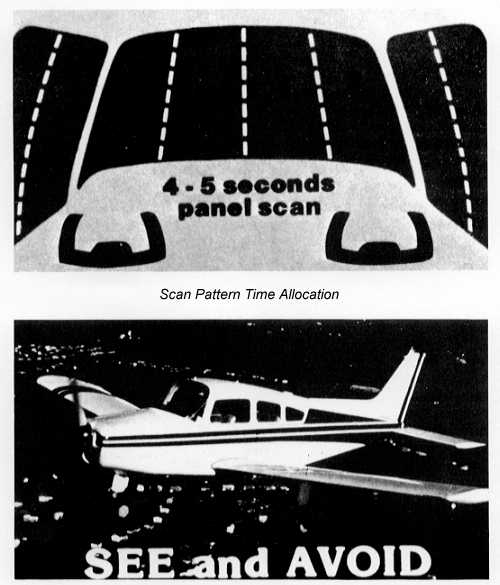
1.  Practice the "see and avoid" concept at all times regardless of whether the operation is conducted under Instrument (IFR) or Visual (VFR) Flight Rules.

2.  Under IFR control, don't always count on ATC to keep you away from other aircraft.  They're human, and can make mistakes.

3.  Understand the limitations of your eyes and use proper visual scanning techniques.  Remember, if another aircraft appears to have no relative motion, but is increasing in size, it is likely to be on a collision course with you.

4.  Execute appropriate clearing procedures before all climbs, descents, turns, training maneuvers, or aerobatics.

5.  Be aware of the type airspace in which you intend to operate in and comply with the applicable rules.

6.  Adhere to the necessary communications requirements.

7. Traffic advisories should be requested and used when available to assist the pilot’s own visual scanning -- advisories in no way lessen the pilot’s obligation to see and avoid.

 8.  If not practical to initiate radio contact for traffic information, at least monitor the appropriate frequency.

 9.  Make frequent position reports along your route and AT UNCONTROLLED AIRPORTS BROADCAST YOUR POSITION AND INTENTIONS ON COMMON TRAFFIC ADVISORY FREQUENCY (CTAF).

 10.  Make your aircraft as visible as possible - turn on exterior lights below 10,000 MSL and landing lights when operating within 10 miles of any airport, in conditions of reduced visibility, where any bird activity is expected or under special VFR clearance.

11.  If the aircraft is equipped with a transponder, turn it on and adjust it to reply on both Mode 3/A and Mode C (if installed).  Transponders substantially increase the capability of radar to see all aircraft and the MODE C feature enables the controller to quickly determine where potential traffic conflicts exist.  Even VFR pilots who are not in contact with ATC will be afforded greater protection from IFR aircraft receiving traffic advisories.

IN ACCORDANCE WITH FAR PART 91.413, WHILE IN CONTROLLED AIRSPACE, EACH PILOT OPERATING AN AIRCRAFT EQUIPPED WITH AN OPERABLE ATC TRANSPONDER MAINTAINED SHALL OPERATE THE TRANSPONDER, INCLUDING MODE C IF INSTALLED, ON THE APPROPRIATE MODE OR AS ASSIGNED BY ATC.  IN CLASS G AIRSPACE, THE TRANSPONDER SHOULD BE OPERATING WHILE AIRBORNE UNLESS OTHERWISE REQUESTED BY ATC.

 12.      ABOVE ALL, AVOID COMPLACENCY


Promoting Aviation Safety is the key .